The lost emergency signal#
Learning goals
Explain the role of frequency regulation in wireless communication and for a telemedicine application
Apply a spectrum analyzer to locate and identify wireless signals based on carrier frequency, signal strength, and duty cycle
Analyze the tradeoffs between transmit power, duty cycle, and bandwidth in the context of SRD regulations
Explain how amplitude modulation encodes information on a carrier signal
Introductory problem
Your professor has been working on an emergency health monitoring system. The device is designed to transmit real-time patient data, such as temperature and oxygen saturation, within an area of about 50 meters. During a late night experiment, due to exhaustion, they forgot where the device prototype was placed. The prototype transmits periodic signals, and it is extremely valuable because it is the only working prototype. To make matters worse, the device is battery-operated, and the battery may soon run out.
Can you help solving the problem?
Finding the lost emergency signal#
Now try to solve the challenge by finding the signal. In the following you will find info and questions that can help you along the way.
Your professor says:
I remember having used something in the range of couple of hundreds MHz.
Transmitting electromagnetic waves can interfere with other systems and therefore this is regulated by the government. I try to be a good citizen and used a frequency which is used in the short-range and does not require any permission from the government.
Which frequency may they have used?
Different frequencies are like parallel communication channels#
If many devices want to communicate with each other without disturbing 1-1 communication, they typically choose different frequencies. But at which frequency is the signal sent?
As citizens, we may not pick any frequency and transmit using the frequency. The government regulates this and sometimes requires license payments for some frequency ranges.
Maybe you remember from other courses the industrial, scientific, medical (ISM) radio band. Examples for ISM applications are RF heating, microwave ovens. Obviously these are not for telecommunication, however these applications may disturb telecommunications. Probably this is the reason why this band is not regulated – if you use it, then you may see interference and you have to deal with this problem. In the linked article above you see 433 MHz, which fits to the hint.
Exercise 1 (Significance of licensing)
Imagine you want to choose a frequency band for a heart implant device with wireless data transmission. What could be the tradeoffs for using a licensed band?
Wikipedia is a secondary source. Let us be more professional and look for a primary source about frequency regulations.
European Conference of Postal and Telecommunications Administrations (CEPT) coordinates telecommunication- and post-related affairs of member countries. One component is the Electronic Communications Committee (ECC). A large group or body typically requires support for tasks like communication, coordination, documentation, etc. The body which is responsible for this tasks is called secretariat, which word you probably know from daily life. The secretariat of ECC is the European Communications Office (ECO).
ECO provides a tool called ECO frequency information system (EFIS). Use the quick search feature and select:
Frequency
from:
433to:
434MHz
Frequency table:
DenmarkClick
Search
You should see text similar to:
Applications:Amateur, Amateur-satellite, Alarms, Model control, Non-specific SRDs
432 MHz - 438 MHz: 5.138
When you hover on the Footnote 5.138, you will see a list of ISM band frequencies, which confirm that 433 MHz is in the ISM band.
Amateur indicates that this band may be used by licensed amateur radio operators. You can get an amateur license you have to pass a test organized by the government. So, you cannot transmit radio waves without getting a amateur radio operator license?
No, you can, but only with a limited energy which ensures limited interference with other devices, e.g., in context of an SRD, which you also see in the excerpt above.
SRD stands for short-range-device. Let us be stringent again and search for government-provided information.
EFIS, which we introduced before, has helpful information on SRDs:
Click on the top right corner on the
Information. A drop-down menu should appearClick on
Short Range Device Information(link). You should see a long list of sub-documents belonging to the documentERC Recommendation 70-03.
An excerpt from the Recommendation Text:
The term “Short Range Device” (SRD) is intended to cover radio equipment which has a low capability to cause interference. The use of SRD is usually covered by general / non-exclusive on a non-protected, non-interference basis. …
Exercise 2 (Significance of SRD frequencies)
What could be the advantage of using an SRD frequency band?
The short-range can be ensured by limiting the power used for transmission, however the effective power in the air will also be dependent on the antenna. A device with a high power but no antenna will typically reach a smaller radius compared to a device with less power but directed antenna. That is the reason why the engineers don’t simply speak of power of RF devices but introduced the concept of effective radiated power (ERP), which is standardized by IEEE.
Below Recommendation Text, we find ANNEX 1 about non-specific SRDs. An excerpt from this document:
Band |
Frequency Range |
Transmit Power |
Duty Cycle |
Additional Notes |
|---|---|---|---|---|
g2 |
433.05MHz - 434.79MHz |
1 mW e.r.p. |
No requirement |
Not specified |
g1 |
433.05MHz - 434.79MHz |
10 mW e.r.p. |
≤ 10% duty cycle |
Not specified |
g3 |
434.04MHz - 434.79MHz |
10 mW e.r.p. |
No requirement |
≤ 25 kHz |
Exercise 3 (Different perspectives to avoid interference)
Why do we have three different rows for the same frequency range with two different Transmit Powers?
We see that the higher transmit powers have additional requirements. If we want to transmit 10 mW ERP instead of 1 mW, then we must either limit our duty cycle or bandwidth around the frequency that we use.
Duty cycle is the relative interval in a transmission period where we utilize the band (e.g., a device transmits only 10% of time, 90% it is silent). A low duty cycle leaves other RF transmitters time to transmit data.
Exercise 4 (Significance of duty cycle)
In the table above, duty cycle ensures that a single transmitter occupies and potentially blocks whole communication channel. On the other hand, it can also have effect on the energy consumption.
How could duty cycle affect energy consumption of a mobile device like a remote pain monitoring system?
How could duty cycle affect the amount of data we can transmit per second? Why could this be important for a mobile monitoring system?
Hints
The higher the duty cycle, the longer the device transmits data.
The amount of data we can transmit per second is limited with a given wireless technology.
What does around mean? When we use radio communication, we typically use a constant carrier frequency as a base and change it according to our needs to encode information. We can for example encode information by varying the carrier frequency or signal’s amplitude. But we want to limit how much we increase/decrease the center frequency, because we want to be a good neighbor. ≤ 25 kHz above is this bandwidth limit and means that we may use the frequencies 12.5 MHz on either side of the center frequency.
Let us put the knowledge we got together. The center frequency is probably from 433.05 to ~435 MHz. It may spread about 25 kHz and can have a duty cycle – assuming that the professor is a good citizen and did not make any mistakes during the night 🤞.
How do I find the carrier frequency?#
We should first search for some signal activity in the spectrum we tuned to. The signal must be larger than the noise so that we can pick the signal up. For example, the following figure shows five peaks in the tuned spectrum:

Fig. 1 Gqrx screenshot showing five peaks in the spectrum above and waterfall diagram below. One is at 3955 kHz.
CC BY-SA 4.0. By Fellegis. Source: Wikimedia Commons#

- Signal strength
Transmitter power output as received by a reference antenna at a distance from the transmitting antenna. It is usually measured in dBm.
First we tune to a specific peak and in the next section we will try to demodulate the signal.
Exercise 5 (Relevance of signal strength)
What does a peak in the spectrum mean?
Why is it important to have a high peak?
How can we increase / decrease the height of a peak?
Why is adjusting the peak important for a mobile system like a remote pain monitoring device?
Hint
Why does your phone call gradually fade when you are in remote areas?
What is the advantage of the flowing diagram below?#
It shows us how the peaks change over time. Besides the spectrum above, this diagram can be useful for finding the signal. The signal should become gradually darker when we move away from the signal.
Blue areas indicate weak or absent signals, while higher signal power appears in red. The colors transition like blue water slowly flowing downward—doesn’t it? This visualization is called a waterfall plot.
How do we demodulate?#
We should first know the modulation technique used. Gqrx already provides some. Try AM. AM modulates the data signal by multiplying the data signal with a carrier signal:

Fig. 2 The modulation of an analog signal into an analog carrier using amplitude modulation (AM).
CC BY-SA 4.0. By Michel Bakni. Source: Wikimedia Commons#

We will cover modulation in detail in next weeks. Right know it is sufficient that you know what is the input and output of modulation and why it is important for communication.
- Signal modulation
the process of varying one or more properties of a periodic waveform in electronics and telecommunication for the purpose of transmitting information.
Exercise 6 (Modulation)
Imagine you have a 1000 m cable between you and your friend. How would you send the message “Come to the lecture, it is pretty fun!” using the cable?
You replace the cable with a wireless system. Would your approach work?
How do we demodulate using GNU Radio?#
To understand the building blocks of demodulation, let us try the demodulation with GNU Radio.
The following flow graph in Fig. 3 can demodulate the signal. Download the flow graph using the link in its title.
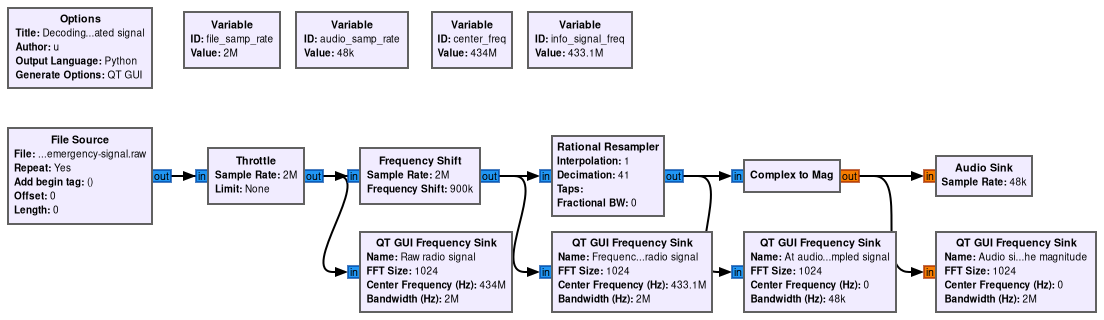
Fig. 3 Flow graph for demodulating an analog signal. gnuradio/am_decode.grc.#
After opening, double click on the File Source and select the recorded waveform that you downloaded when you were testing Gqrx.
Start the flow graph using ▶️ to see whether you can see or hear the message you heard previously. It will likely not be able to hear it, because the signal strength is very low, i.e., it is a weak signal. However, you will see the intermittent signal we saw previously in the waterfall diagram in Gqrx.
Let us shortly analyze it, even we will introduce some concepts in the next chapter in detail.
Exercise 7 (Analyzing the block outputs)
What do the
Frequency Sinkblocks do?Describe what each block does by differentiating what each
Frequency Sinkshows.Could you hear the signal? If you had to modify or add something, what did you do?
If you could not hear the signal, make the voice signal louder by using the
GUI Rangewidget to create a volume slider.
Exercise 8 (Spectrum analyzer in GNURadio (optional))
Create a spectrum analyzer that shows you similar output to Gqrx — with a frequency spectrum window and a waterfall diagram.